Bitmain Antminer S21 Series Review: All Antminer S21 Variants Compared
Bitmain Antminer S21 Series Review 2026: All Antminer S21 Variants Compared — specs, noise, PSU, and breakeven rates for every model.
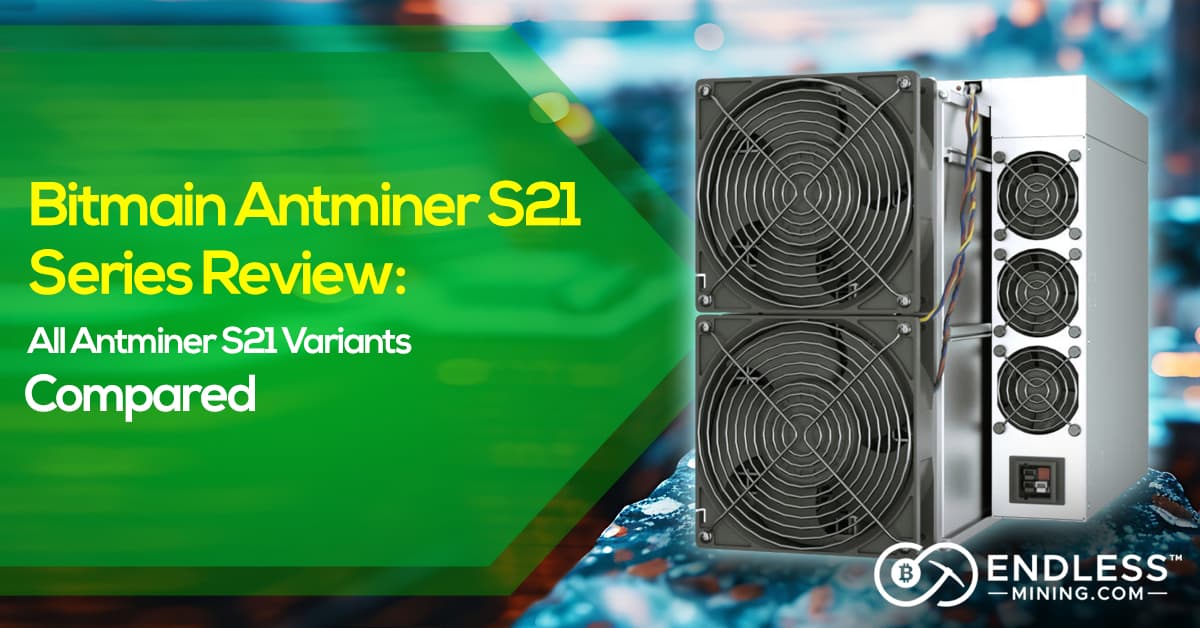
TL;DR — All Antminer S21 Variants Compared in 30 Seconds
- The base S21 delivers 200 TH/s at 17.5 J/TH and remains the budget entry point.
- The S21 Pro steps up to 234 TH/s at 15 J/TH using upgraded BM1370BC chips.
- The S21 XP leads air-cooled models at 270 TH/s and 13.5 J/TH efficiency.
- The S21 Hyd and S21 XP Hyd use liquid cooling for serious hashrate density.
- All air-cooled S21 models need the APW17 PSU, not the older APW12.
- Real-world noise sits at 73 to 76 decibels, so this isn't a living-room device.
- Most S21 models stay profitable below $0.10 to $0.12 per kWh in 2026.
- US buyers now face lower real import costs than most outdated articles suggest.
- The S21+ uses a unique 11 voltage domain layout across 55 BM1370BC chips.
- Home miners should look at the S21 or S21 Pro, not the industrial Hyd models.
What Makes the S21 Series Different
Bitmain released the S21 family as its flagship follow-up to the S19 line. Basically, every variant chases the same goal. More hashrate per watt. That efficiency jump matters a lot once power costs enter the picture.
Also, compared to the S19j Pro at 29.5 J/TH, even the base S21 marks a big leap forward. Plus, the S21 XP pushes efficiency down to 13.5 J/TH. That's nearly a 40% drop in power cost per terahash. That's a huge deal for anyone running machines around the clock.
So why does Bitmain split this into six variants instead of one? Simple. Basically, different buyers want different tradeoffs. Price, hashrate, and cooling hassle all pull in different directions. That's exactly why All Antminer S21 Variants Compared matters as one single reference. It beats chasing scattered spec sheets across ten different sites.
All Antminer S21 Variants Compared: The Naming Decoder
Honestly, Bitmain's naming convention trips up a lot of buyers. So let's break it down fast, one tier at a time.
First, the base **S21** uses older BM1368 chips. It packs 108 chips per hashboard, delivering 200 TH/s. It's the workhorse and the cheapest way into the family.
The **S21+** switches to 55 BM1370BC chips per hashboard instead. Those chips split across 11 voltage domains. This unusual layout helps balance heat and power stability across the board.
Next, the **S21 Pro** uses 65 BM1370BC chips per hashboard. It sits above the base model in both hashrate and efficiency. That lands it at 234 TH/s and 15 J/TH.
The **S21 XP** is Bitmain's top air-cooled model at 270 TH/s and 13.5 J/TH. Meanwhile, the **S21 Hyd** and **S21 XP Hyd** move to liquid cooling entirely. They hit 335 TH/s and up to 473 TH/s. So basically, think of it as a ladder. Standard, Plus, Pro, XP, then Hyd variants at the top for serious scale.
All Antminer S21 Variants Compared: Full Spec Table
Here's the full lineup with verified 2026 numbers. So you don't have to hunt across five different pages.
| Variant | Chip | Hashrate | Efficiency | Cooling | Price Range (USD) |
|---|---|---|---|---|---|
| S21 | BM1368 | 200 TH/s | 17.5 J/TH | Air | ~$2,800-3,400 |
| S21+ | BM1370BC | ~215 TH/s | ~16 J/TH | Air | ~$3,000-3,600 |
| S21 Pro | BM1370BC | 234 TH/s | 15.0 J/TH | Air | ~$3,600-4,200 |
| S21 XP | BM1370BC | 270 TH/s | 13.5 J/TH | Air | ~$4,500-5,300 |
| S21 Hyd | BM1370BC | 335 TH/s | 16.0 J/TH | Liquid | ~$5,800-6,800 |
| S21 XP Hyd | BM1370BC | 473 TH/s | ~13.0 J/TH | Liquid | ~$8,500-9,800 |
Notice the pattern here. So hashrate climbs fast toward the top. But efficiency doesn't always improve in a straight line. The Hyd model trades some efficiency for raw hashrate density instead. That's a real tradeoff worth understanding before you buy.
Chip Architecture: Why the Variants Differ
Here's where things get technical. But stick with us, because it actually matters. The base S21 runs 108 BM1368 chips per hashboard. That's an older chip generation. Still solid, but not the newest silicon Bitmain offers.
Everything above the base model switches to BM1370BC chips instead. However, chip count per hashboard changes a lot between variants. The S21+ spreads 55 chips across 11 separate voltage domains. That helps manage heat more precisely. The S21 Pro uses 65 chips per board instead. It trades some voltage flexibility for raw density.
So why does this matter to you as a buyer? Because chip architecture affects repairability. These boards wire chips in series. So a single failed chip can take down an entire chain. Finding and fixing that one bad chip often beats scrapping a whole board, especially on pricier XP and Hyd models.
Basically, more chips per board means more hashrate. It also means more heat to manage. And it means more failure points over the miner's lifespan.
PSU and Noise — All Antminer S21 Variants Compared
Let's talk power supplies first, since this trips up a lot of new buyers. First off, every air-cooled S21 variant needs the Bitmain APW17. It's rated at 3,600 watts and uses the newer P13 connector. So your older APW12 unit from the S19 days won't work without an adapter cable.
Now for noise, and honestly, this part matters more than most buyers expect. Real-world tests put the S21 family at 73 to 76 decibels at one meter. That lines up with Bitmain's official 75 dB rating. It's roughly as loud as a vacuum cleaner running nonstop.
So this isn't a bedroom device, plain and simple. You'll want a garage, basement, or spare mining closet with decent airflow. Undervolting can shave 5 to 12 decibels off that number. You'll trade a bit of hashrate for some peace and quiet, though.
Also worth noting, the Hyd variants run quieter since liquid cooling handles heat without loud fans. That's a real perk if noise is a dealbreaker for your setup.
Cooling and Ventilation Tips for Any S21 Variant
A hot miner is a slow miner, so airflow matters just as much as the spec sheet. First, give every unit at least a few inches of clearance on both sides. Also, cramped spacing traps hot air and forces the fans to work overtime.
Next, think about intake and exhaust separately. Cool air needs to come from somewhere, and hot air needs somewhere to go. A simple duct shroud routing exhaust outside works wonders in a garage or shed setup.
For the Hyd variants, plan your plumbing loop before the unit shows up at your door. Liquid cooling needs a radiator, pump, and coolant reservoir, so it's a bigger commitment than plugging in a fan-cooled box.
Basically, spend a weekend on airflow planning before you power anything on. It saves you from thermal throttling down the road, and it stretches the life of your hardware too.
Profitability and Breakeven Rates in 2026
Here's the number that actually decides whether any of this makes sense for you. So as of early 2026, the base S21 stays profitable below roughly $0.12 per kWh. Meanwhile, the S21 XP holds a lower breakeven around $0.09 per kWh. That's thanks to its better efficiency.
Meanwhile, with Bitcoin's network hashrate sitting around 890 EH/s in 2026, older and less efficient machines feel the squeeze fastest. So if your power rate creeps above $0.10 per kWh, the efficiency gap starts costing you real cash every day.
0
For most home miners running one or two units, the S21 Pro often makes more sense than the XP. It delivers about 90% of the XP's efficiency at a noticeably lower price. Basically, the extra efficiency on the XP takes longer to pay back. That's true unless you're running a bigger fleet or paying above-average power rates.
US Pricing and Import Costs in 2026
Here's something a lot of comparison articles still get wrong. Plenty of sites quote old 2025 tariff numbers. They cite rates around 47% on hardware shipped from Southeast Asia. That's old info now.
After a February 2026 Supreme Court ruling struck down IEEPA-based tariffs, real landed costs from Southeast Asia now sit closer to 27 to 28% for US buyers. That's a meaningful gap. Compare an $8,500 S21 XP Hyd against a $2,800 base S21, and the math shifts a lot depending on which tariff figure a seller actually uses.
So before you commit to a purchase, always check current listings instead of trusting a stale blog post. Prices and duties shift often in this market. A live marketplace reflects reality far better than a spec sheet written months ago.
Which S21 Variant Should You Buy?
Let's make this simple with a quick buyer path through All Antminer S21 Variants Compared.
Running one or two units at home with average electricity rates? The base S21 or S21 Pro covers you nicely. You won't overspend on efficiency you can't fully use anyway.
Running a small farm with ten or more units and tighter power costs? The S21 XP earns back its higher price through daily efficiency savings.
Running a hosted or industrial-scale operation above a megawatt? The S21 Hyd or XP Hyd unlocks hashrate density and heat-reuse options. Air-cooled units simply can't touch that.
Want the deep one-on-one breakdown between two specific models instead? Check out our full Antminer S21 Pro vs S21 XP comparison for breakeven timelines and real-world hashrate variance.
Resale Value and the Upgrade Path
Here's something worth thinking about before you buy. ASIC hardware loses value fast once a newer, more efficient chip hits the market. The S21 family already faces pressure from Bitmain's newer S23 lineup, which pushes efficiency even lower.
That doesn't mean the S21 series is a bad buy in 2026. Far from it. But if resale value matters to you, the S21 XP and Pro tend to hold value better than the base model. Their efficiency numbers stay competitive longer as network difficulty climbs.
So think of any S21 purchase as a three to four year asset, not a lifetime one. Plan your electricity math around that window, and you'll come out ahead even after the next generation ships.
Final Verdict: All Antminer S21 Variants Compared
If we had to rank these six variants for 2026 buyers, here's how it lands. The S21 XP wins on pure efficiency and long-term savings for fleet operators. The S21 Pro wins on value for home and small-scale miners. The base S21 wins on upfront affordability. The Hyd variants win on raw hashrate density for industrial buyers who can handle liquid cooling setups.
Bottom line, there's no single "best" S21. There's only the right variant for your electricity rate, your scale, and your tolerance for noise and complexity.
FAQ: All Antminer S21 Variants Compared
What is the difference between the S21 and S21 Pro?
The base S21 uses older BM1368 chips and delivers 200 TH/s at 17.5 J/TH. The S21 Pro switches to newer BM1370BC chips. That pushes hashrate to 234 TH/s and efficiency to 15 J/TH. So the Pro costs more, but it pays that back faster through lower power bills.
Do all S21 variants use the same power supply?
No. Air-cooled models need the Bitmain APW17, rated at 3,600 watts with a P13 connector. Your older APW12 from S19-era machines won't work without an adapter cable. So budget for a new PSU if you're upgrading from S19 hardware.
How loud is the Antminer S21 series?
Real-world testing shows 73 to 76 decibels at one meter. That's similar to a vacuum cleaner running nonstop. So you'll need a garage, basement, or dedicated space rather than a living area.
Which S21 variant is most profitable in 2026?
The S21 XP holds the lowest breakeven rate at around $0.09 per kWh, thanks to its 13.5 J/TH efficiency. That said, the S21 Pro often makes more financial sense for smaller setups, since it costs less upfront.
Is the S21 Hyd worth the higher price?
Only for larger or hosted operations. The Hyd variants deliver serious hashrate density and quieter running through liquid cooling. But the setup and upfront cost only pay off once you're at real scale.
Do US import tariffs still make these miners more expensive?
Less than most articles claim. After the February 2026 Supreme Court ruling on IEEPA tariffs, real rates on Southeast Asian imports now sit around 27 to 28%. That's well below the outdated 47% figure still floating around online.
Can I repair a failed chip instead of replacing the whole board?
Yes, and it's often the smarter move. Since S21 hashboards wire chips in series, one failed chip can take the whole chain offline. Fixing that single chip usually costs far less than replacing an entire hashboard.
Who Should Skip the S21 Series in 2026
Honestly, the S21 lineup isn't the right call for everyone. If your electricity rate sits above $0.15 per kWh, even the S21 XP struggles to stay comfortably profitable once difficulty keeps climbing. In that case, hosted mining in a cheaper-power region often makes more sense than running hardware at home.
Also, if noise is a total dealbreaker and you don't have a garage or basement, skip this series entirely. At 73 to 76 decibels, there's no realistic way to make an air-cooled S21 quiet enough for shared living space. A smaller open-source miner fits that use case much better.
That said, if you've got decent power rates, some space to dedicate, and you want serious hashrate without industrial-scale investment, the S21 family still delivers real value in 2026. Just go in with clear eyes about the noise and heat tradeoffs first.
Quick Glossary: Key Terms in This Guide
A few terms come up a lot here, so let's define them fast. J/TH means joules per terahash. It's the main way to measure ASIC efficiency. Lower is always better.
TH/s stands for terahashes per second. That's your raw hashrate, or how much math the machine crunches. PSU just means power supply unit, the box that feeds electricity to your miner.
Breakeven rate is the electricity price where your miner stops making money. Above that number, you're losing cash daily. Below it, you're stacking sats.
So keep these terms handy as you read through the rest of this guide. They pop up in nearly every section, and understanding them makes the whole buying decision way easier.
Ready to Mine Smarter? Meet EndlessMining.com
If you’re serious about crypto mining, challenges like— trust, accountability, security, and efficiency — are problems you face every day. That’s exactly why EndlessMining.com was built.
EndlessMining.com is the mining hardware marketplace that actually has your back:
🛒 Buy & Sell Mining Hardware — Browse a curated marketplace connecting miners, dealers, and buyers worldwide.
🏠 Hosting Services — Skip the overhead. Let EndlessMining host your miners in professional facilities so you can focus on returns.
💡 Mining Consultancy — Get expert guidance on equipment selection, setup, and optimization from people who live and breathe mining.
🧮 Mining Calculator — Run the numbers before you commit. Estimate profitability based on your hardware, power costs, and current network conditions.
🔒 Escrow-Protected Transactions — EndlessMining.com is currently the only crypto miner marketplace officially partnered with Escrow.com, meaning every transaction is protected. No scams. No chargebacks. No uncertainty. In a space defined by trustlessness, Endlessmining.com offers something rare: accountability you can count on.