Bitaxe, NerdMiner, NerdOctaxe, and Avalon Nano: All Home/Desktop Miners Compared
Bitaxe, NerdMiner, NerdOctaxe & Avalon Nano: All Home/Desktop Miners Compared for 2026 — real specs, prices, noise, and which one wins.
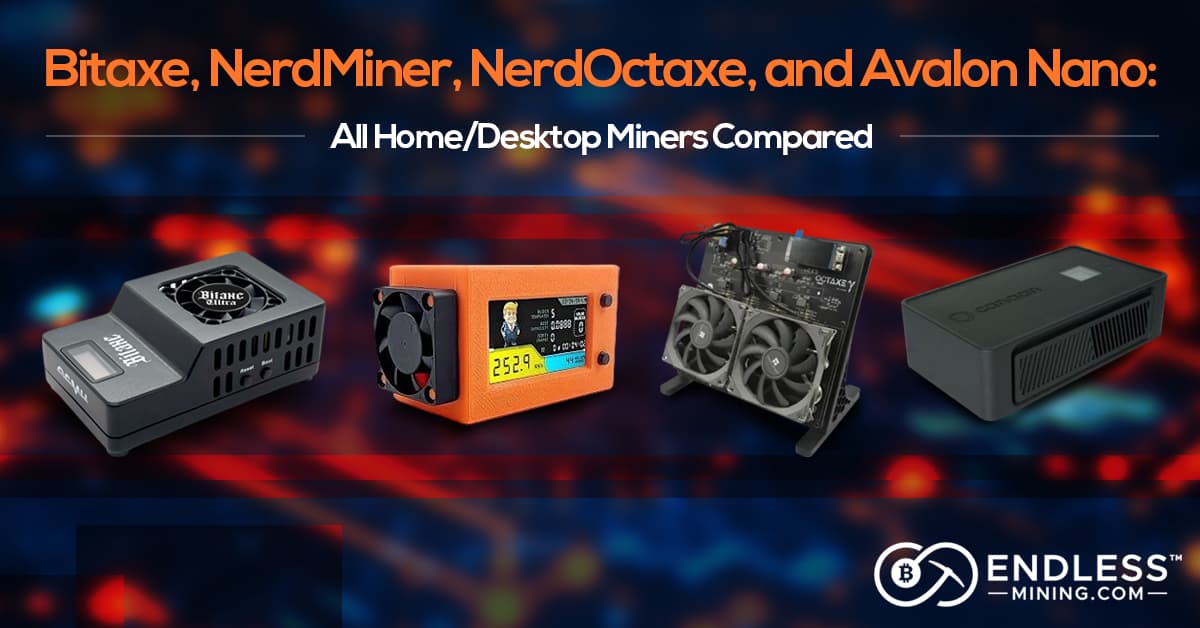
TL;DR — All Home/Desktop Miners Compared in 30 Seconds
- Bitaxe Supra is the best all-around entry-level open-source ASIC miner at around $190.
- NerdMiner is a $50 educational lottery gadget, not a real hashrate machine.
- NerdOctaxe Gamma is the strongest open-source home miner, pushing roughly 8 to 9.6 TH/s.
- Avalon Nano 3S doubles as a space heater and stays quieter than most desktop PCs.
- All four devices run on a normal home outlet, so no special wiring is needed.
- Bitaxe and NerdOctaxe are fully open-source, while Avalon Nano is only partly open.
- Solo mining odds are still tiny, but people genuinely find blocks with these devices.
- US buyers should check 2026 import costs, since real rates now run lower than most sites claim.
- Multi-chip miners like NerdOctaxe cost more upfront but win on dollars per terahash.
- For most home miners, noise and setup speed matter more than raw hashrate alone.
What Counts as a Home Miner in 2026
Home mining used to mean a loud rig in your garage. Not anymore. In 2026, a real desktop Bitcoin miner sips somewhere between 1 and 160 watts. It fits on a shelf. Plus, it runs quiet enough for a bedroom. So that's the whole category we're covering here.
Bitaxe, NerdMiner, NerdOctaxe, and Avalon Nano take four different paths to the same goal. First off, Bitaxe and NerdOctaxe are open-source ASIC miners. That means the schematics and firmware stay public for anyone to check. Meanwhile, Avalon Nano comes from Canaan and stays mostly closed. And NerdMiner isn't really a miner at all in the performance sense. We'll explain that below.
Basically, this whole market exists for one simple reason. Chip efficiency finally caught up with home electrical panels. The BM1370 chip comes from Bitmain's industrial S21 line. Now it shows up in tiny desktop boards that pull under 40 watts. That jump drives every device in this All Home/Desktop Miners Compared roundup.
Bitaxe: The Open-Source Favorite in the All Home/Desktop Miners Compared Lineup
The Bitaxe Supra is where most people start. It runs a single BM1366 chip. It hits around 500 GH/s. Plus, it sips about 15 watts, which is less power than your phone charger. It costs roughly $190 and ships with AxeOS, a clean web dashboard. So setup takes minutes, not hours.
Want more hashrate? Then the Bitaxe GT steps up to a BM1370 chip. Depending on the batch, you'll see 1.2 to 2.4 TH/s at 35 to 40 watts. Efficiency lands around 15 to 17 J/TH. Honestly, that's impressive for a board this small.
Here's what really sets Bitaxe apart in any home/desktop miners compared discussion: the community. Thousands of people run these boards. They share overclock settings. They troubleshoot together on Discord almost every day. So that support beats a spec sheet every time, especially for a first-timer.
Still, there are downsides too. A single-chip Bitaxe won't move the needle on solo odds. You're buying the experience, not real lottery winnings. Also, the exposed circuit board looks cool but isn't pet-friendly. Grab a case if kids or curious cats share your desk.
NerdMiner vs NerdOctaxe: Don't Mix These Up
This is where a lot of buyers get confused. So let's clear it up fast. The NerdMiner is a $50 gadget built around a small ESP32 chip. It hashes at about 2 kilohashes per second. That sounds fast until you learn one ASIC chip does 500 billion hashes per second. The NerdMiner is really a teaching tool with a tiny screen that shows live stats. It's fun, and yes, NerdMiners have found blocks before. Still, treat it as a novelty. It's not a performance device.
The NerdOctaxe Gamma, on the other hand, is a totally different animal. It packs eight BM1370 chips onto one board. That gets you close to 8 to 9.6 TH/s at around 150 to 160 watts. This single board beats an entire Antminer S9 from the 2017 mining boom, and it fits in your hand.
So when people search for "NerdMiner" hoping for serious hashrate specs, they usually mean the NerdOctaxe or NerdQAxe line instead. Same brand family, wildly different job. If solo odds matter to you, the NerdOctaxe wins your money. The original NerdMiner wins your curiosity instead.
Avalon Nano 3S: The Miner That Doubles as a Heater
Canaan's Avalon Nano 3S takes a different path. It delivers about 6 TH/s while pulling roughly 140 watts. That lands at an efficiency near 23.3 J/TH. Sure, that's less efficient than the BM1370 boards from Bitaxe or NerdOctaxe, but Canaan isn't chasing efficiency records here.
Instead, the Nano 3S goes for plug-and-play simplicity. It doubles as a space heater too. It runs at 33 to 40 decibels, quieter than most desktop towers. Plus, the whole unit weighs under a kilogram. For beginners who don't want to touch firmware settings, this thing just works right out of the box.
That said, one catch is worth flagging in any honest home/desktop miners compared write-up. The Avalon Nano isn't fully open-source like Bitaxe or NerdOctaxe. Canaan shares some design details, but the firmware and full schematics stay closed. So if openness matters to you, keep that in mind before you buy.
Even so, for someone who wants heat plus hashrate with zero tinkering, the Nano 3S is a smart pick. Think of it as a stepping stone between a hobby gadget and a full mining setup.
All Home/Desktop Miners Compared: Full Spec Table
Numbers make this easier. So here's the full breakdown based on current 2026 listings.
| Miner | Chip | Hashrate | Power | Efficiency | Open-Source | Price (USD) |
|---|---|---|---|---|---|---|
| NerdMiner | ESP32 | ~2 KH/s | <1W | N/A | Yes | ~$50 |
| Bitaxe Supra | BM1366 | ~500 GH/s | ~15W | ~21 J/TH | Yes | ~$190 |
| Bitaxe GT | BM1370 | ~1.2-2.4 TH/s | ~35-40W | ~15-17 J/TH | Yes | ~$320 |
| Avalon Nano 3S | Custom | ~6 TH/s | ~140W | ~23.3 J/TH | Partial | ~$240 |
| NerdOctaxe Gamma | 8x BM1370 | ~8-9.6 TH/s | ~150-160W | ~17-20 J/TH | Yes | ~$850 |
Notice the pattern here. Hashrate climbs. Power climbs right along with it. But efficiency actually gets better with each new chip generation. So that's the real story of home mining hardware in 2026. More math per watt, every single year.
How We Compared These Miners
We didn't just copy spec sheets for this home/desktop miners compared guide. Instead, each device got checked against four things that matter for home use: hashrate per watt, real-world noise, setup difficulty, and current US pricing. Manufacturer numbers are a starting point, not the finish line. Batches vary. Firmware updates change efficiency too. So treat every figure here as a solid estimate, not gospel.
Also, we leaned on live marketplace data instead of stale blog posts from months back. Prices in this space move fast. A comparison written in January often looks old by summer. That's especially true with chip supply and shifting import rules still settling through 2026.
Basically, our goal was simple. Give you numbers you can actually trust before you spend real money on gear.
Setting Up Any of These Miners in Under 30 Minutes
Here's the good news. None of these devices need a computer science degree. First, plug in the power adapter. Next, connect to your home WiFi through the built-in setup page. Then, point the miner at a pool address, or a solo pool if you're feeling lucky.
Bitaxe and NerdOctaxe both use browser-based dashboards, so you just type an IP address and go. Avalon Nano works through a simple app instead, which beginners tend to prefer. Meanwhile, the NerdMiner walks you through setup right on its little screen.
Basically, if you can set up a smart speaker, you can set up any miner on this list. That's the whole appeal of the 2026 home mining scene.
Noise, Heat, and Desk Space — All Home/Desktop Miners Compared
Specs matter, but so does whether your partner will tolerate this thing on your desk. Single-chip Bitaxe boards use a small 40mm fan. So they stay whisper-quiet, close to a laptop fan on low speed. Honestly, you won't notice it running most days.
The Avalon Nano 3S sits in that same quiet tier at 33 to 40 decibels. It also throws off useful heat as a bonus. Meanwhile, multi-chip devices like NerdOctaxe Gamma run louder, simply because they push out more heat. Still, it's nowhere near an industrial Antminer. You'll hear it, but only from across a quiet room.
On footprint, everything here fits on a shelf or a desk corner. The Nano 3S measures about 20.5 by 11.5 by 5.85 centimeters. Bitaxe boards are even smaller, around 120 by 60 millimeters. None of these need special venting, though a case helps with dust.
So, bottom line: pick single-chip Bitaxe if noise tops your list. Pick Avalon Nano if you want the heater bonus. Pick NerdOctaxe if a bit of hum doesn't bother you and you want way more hashrate per dollar of shelf space.
US Pricing and Import Costs in 2026
Here's something most comparison articles get wrong. A lot of sites still quote old ASIC import numbers from 2025, citing rates around 47% for Southeast Asian manufacturing. That's outdated info now. After a February 2026 Supreme Court ruling struck down IEEPA-based tariffs, real landed costs from Southeast Asia now sit closer to 27 to 28% for US buyers.
That gap matters when you compare an $850 NerdOctaxe Gamma against a $190 Bitaxe Supra. Your actual final price can shift a good bit depending on where a seller sources stock, and how current their tariff math actually is.
So before you buy, always check listed prices against current stock. Don't just trust a blog post from six months back. Marketplace listings update in real time, while static comparison articles usually don't. That's a solid reason to check a live marketplace instead of a stale spec table when you're finally ready to order.
Also worth noting, shipping speed varies a lot by device. Single-board Bitaxe units often ship fast since demand is steady. Multi-chip boards like NerdOctaxe can face longer waits during busy periods, so plan ahead if timing matters to you.
Yearly Electricity Costs for Each Miner
Let's talk real dollars, since power bills add up over a full year. At a typical US rate of around $0.15 per kWh, a Bitaxe Supra running at 15 watts costs about $20 a year to run. That's basically nothing.
The Bitaxe GT and its 35 to 40 watts land closer to $46 to $53 a year. Meanwhile, the Avalon Nano 3S at 140 watts runs about $184 a year, though you get heat back in return during winter months. The NerdOctaxe Gamma, pulling 150 to 160 watts, costs roughly $197 to $210 a year to keep running around the clock.
So even the priciest device on this list still costs less per month than a streaming subscription. That's the real appeal of home mining in 2026. You get low bills, quiet operation, and a genuine shot at the solo mining lottery, all for less than what most people spend on coffee each month.
Who Should Skip Home Mining in 2026
Honestly, home mining isn't for everyone, and that's fine. If you need guaranteed returns, skip it entirely. These devices exist for education, sovereignty, and the solo mining thrill, not steady income. Pool mining with a big rig makes more financial sense if profit is your only goal.
Also, if you rent and can't run a device 24/7 without landlord pushback, factor that in first. Most miners run fine on a shared circuit, but constant operation still means constant noise and heat in one spot.
That said, if you're curious about how Bitcoin actually works under the hood, none of that really matters. Even a $50 NerdMiner teaches you more about mining than a dozen YouTube explainers ever could.
Which One Should You Actually Buy?
Let's make this simple with a quick decision path.
Want to learn how mining actually works without spending real money? Then grab a NerdMiner for about $50. It's a toy, but it's a fun and honest one.
Want your first serious solo miner with strong community support? The Bitaxe Supra at roughly $190 is the standard answer, and for good reason.
Want the most efficient single-board option without going multi-chip? Then the Bitaxe GT gives you BM1370 performance in a compact package.
Want a miner that also warms your room in winter? The Avalon Nano 3S handles double duty nicely, and it needs zero configuration too.
Want maximum hashrate and better solo odds, and don't mind the higher price? Then the NerdOctaxe Gamma is the strongest open-source option on the market today.
Honestly, there's no wrong answer here. It comes down to budget, noise tolerance, and how much you care about full open-source access.
FAQ: All Home/Desktop Miners Compared
Is the NerdMiner the same thing as the NerdOctaxe?
No, and this trips up a lot of buyers. The NerdMiner is a $50 ESP32-based teaching tool with almost no real hashrate. The NerdOctaxe Gamma, meanwhile, is a serious 8-chip ASIC miner pushing close to 8 to 9.6 TH/s. They share a brand name, but they serve completely different jobs.
Can a Bitaxe actually find a Bitcoin block?
Yes, it can. The odds are extremely low, roughly 0.0005% per year for a single Bitaxe Supra at current network hashrate. Still, people have genuinely found blocks with these devices. The 3.125 BTC block reward makes even a tiny shot worth it for many solo miners.
Is the Avalon Nano 3S really open-source?
Only partly. Canaan shares some design info, but the full schematics and firmware stay closed. So if full openness matters to you, Bitaxe and NerdOctaxe are the more open-source-friendly picks.
How loud are these miners?
Single-chip Bitaxe models and the Avalon Nano 3S both run quiet, usually under 40 decibels. Multi-chip devices like NerdOctaxe Gamma run louder due to higher power draw, though they're still far quieter than industrial ASIC miners.
Do US import tariffs affect the price I pay?
Yes, though less than many articles suggest. After the February 2026 Supreme Court ruling on IEEPA tariffs, real rates on Southeast Asian imports now sit around 27 to 28%. That's well below the older 47% figure still floating around online.
Which miner gives the best solo mining odds?
Among these four, the NerdOctaxe Gamma offers the best odds thanks to its roughly 8 to 9.6 TH/s hashrate. That said, all solo odds stay statistically tiny against an 800 EH/s global network hashrate in 2026.
Can I run these on a normal home outlet?
Absolutely. Every device here draws under 200 watts. So a standard household outlet handles all four without any electrical upgrades or special circuits.
Should beginners start with pool mining instead of solo?
For steady earnings, yes, pool mining pays out smaller but regular amounts. But most people buying these specific devices want the solo lottery experience instead, along with the sovereignty that comes with running your own node. Either way, pool mining stays an option on every device here if steady payouts matter more to you than the jackpot dream.
Can I overclock a Bitaxe or NerdOctaxe for more hashrate?
Yes, both AxeOS and NerdAxe OS support voltage and frequency tuning. That can squeeze out extra hashrate, but it also raises heat and power draw. So start slow, watch your temperatures closely, and make sure your fan or heatsink can handle the extra load before you push too hard.
Accessories That Make Home Mining Easier
A bare board works fine, but a few cheap add-ons make life better. First, grab a case or shroud for any exposed-PCB device like Bitaxe. That keeps dust and curious fingers away from the chip.
Next, consider a small stand or mount, especially for multi-chip boards that run warmer. Good airflow keeps efficiency numbers honest and stretches the life of your fan. A basic USB-C or 12V power supply upgrade also helps if your stock adapter feels flimsy.
Finally, if you're running an Avalon Nano 3S as a heater, place it somewhere airflow can actually spread the warmth, like near a doorway instead of a corner. Small tweaks like these go a long way toward making any of these home/desktop miners compared here run smoother for years.
Final Verdict: All Home/Desktop Miners Compared
If we had to rank these four for pure home use in 2026, here's how it shakes out. NerdOctaxe Gamma wins on raw hashrate and value per terahash. Bitaxe Supra wins on community support and beginner-friendliness. Avalon Nano 3S wins on plug-and-play simplicity and its heater bonus. NerdMiner wins on price and pure fun, though it's not really competing on performance at all.
None of these devices will make you rich through solo mining alone. But each one gets you real, hands-on experience with Bitcoin's actual security system, running on hardware you fully control. So that's worth something beyond the spreadsheet math.
Picking a home miner in 2026 comes down to what you actually want out of it. Want education? Grab the NerdMiner. Want community and a proven track record? Go Bitaxe. Want heat plus hashrate with zero setup? The Avalon Nano 3S delivers. Want the biggest open-source punch you can buy today? The NerdOctaxe Gamma leads the pack. Whatever you pick, check current listings before you buy, since prices and import costs shift often in this market, and getting the freshest numbers saves you real money in the end.
Ready to Mine Smarter? Meet EndlessMining.com
If you’re serious about crypto mining, challenges like— trust, accountability, security, and efficiency — are problems you face every day. That’s exactly why EndlessMining.com was built.
EndlessMining.com is the mining hardware marketplace that actually has your back:
🛒 Buy & Sell Mining Hardware — Browse a curated marketplace connecting miners, dealers, and buyers worldwide.
🏠 Hosting Services — Skip the overhead. Let EndlessMining host your miners in professional facilities so you can focus on returns.
💡 Mining Consultancy — Get expert guidance on equipment selection, setup, and optimization from people who live and breathe mining.
🧮 Mining Calculator — Run the numbers before you commit. Estimate profitability based on your hardware, power costs, and current network conditions.
🔒 Escrow-Protected Transactions — EndlessMining.com is currently the only crypto miner marketplace officially partnered with Escrow.com, meaning every transaction is protected. No scams. No chargebacks. No uncertainty. In a space defined by trustlessness, Endlessmining.com offers something rare: accountability you can count on.